

Glossary of Prints
Here are a few definitions for the main terms used to talk about prints.
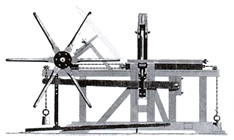 Original Print is the correct term used to talk about any work that is drawn, painted, or engraved by an artist on various supports - stone, metal, wood, linoleum, celluloid, rhodoid and that is afterwards inked and printed on paper using a press.
When several copies are printed, the term applied is edition and it starts from a proof called the" bon à tirer".
Original Print is the correct term used to talk about any work that is drawn, painted, or engraved by an artist on various supports - stone, metal, wood, linoleum, celluloid, rhodoid and that is afterwards inked and printed on paper using a press.
When several copies are printed, the term applied is edition and it starts from a proof called the" bon à tirer".
This usually mentions the number of copies that the artist and the publisher intend to print. The printer must then check that all printed copies correspond to the proof that the artist passed for press. All the prints are then signed by the artist and numbered by the artist or the publisher.
A few of these prints are reserved for the artist, recognizable thanks to a number system which is different from that of the rest of the edition, or even because they are not numbered. These are called artists' proofs.
Before the initial proof is passed for press, a few copies are printed to choose the paper, the inks and so on. These are called trial proof.
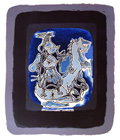 The technique of lithography is based on the repulsion of water by the fat contained in lithographic inks.
With this technique there is no engraving; the lithographic stone is never engraved and therefore lithographs require as many stones as there are colours; because of this, today zinc plates are preferred.
The technique of lithography is based on the repulsion of water by the fat contained in lithographic inks.
With this technique there is no engraving; the lithographic stone is never engraved and therefore lithographs require as many stones as there are colours; because of this, today zinc plates are preferred.
The artist draws in pencil or paints in lithographic ink on the surface of a lithographic stone - a chalky stone that absorbs humidity.The whole surface of the stone is then covered with water that the stone will absorb in all areas except those covered in ink. Afterwards an ink roller is run over it; the ink is repulsed by the water, but absorbed in the areas drawn or painted by the artist. Finally the lithograph is done by pressing a sheet of paper on the stone.
The artist may also draw on a sheet of lithographic paper that is then transferred to the stone.
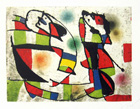 Engraving is the generic term used to talk about any work engraved on a metal support.
To create a dry-point etching, the artist works with a steel pencil, scoring a metal plate.
In the case of etching, the metal plate is covered with an insulating varnish through which the artist does the engraving.
Engraving is the generic term used to talk about any work engraved on a metal support.
To create a dry-point etching, the artist works with a steel pencil, scoring a metal plate.
In the case of etching, the metal plate is covered with an insulating varnish through which the artist does the engraving.
The plate is then dipped into a bath of acid (eau-forte) which will erode only the engraved parts, since the varnish will protect the rest. Aquatint is used to obtain a wash drawing effect.
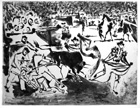 The plate is coated with grains of resin that are then heated; they will therefore fuse together but not homogeneously - empty areas will remain between the melted grains.
The metal plate is then dipped into an acid and will be eroded in the uncoated areas; depending on their size and the impact of acid erosion, they will range from grey to deep black. For these three techniques, the finished prints are done by laying a piece of paper on the metal plate.
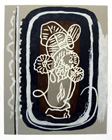 For woodcut, the artist works on a wood plate using a gouge or wood chisel. Sometimes from a first drawing made on the plate.
Besides the specificity of wood as a support, what makes this technique difficult is that the artist must remove from the plate everything that is not to be inked.
For woodcut, the artist works on a wood plate using a gouge or wood chisel. Sometimes from a first drawing made on the plate.
Besides the specificity of wood as a support, what makes this technique difficult is that the artist must remove from the plate everything that is not to be inked.
After doing this, an ink roller is run over the surface and a piece of paper is applied using a press.
Linocut is similar to woodcut, the only difference is that the artist here uses a linoleum plate as support.